Aramco publishes its supplier registration rules in detail. They still branch quickly. Where your company is based decides the route, your supplier type decides the forms, and iktva runs alongside both.
Short answer: Aramco says any company that wants to do business with it must register through its e-Marketplace Platform. Suppliers in the other GCC states and a named list of countries register through Dhahran; suppliers elsewhere are directed to the regional Aramco affiliate. In-Kingdom suppliers follow a published document list that includes a Cybersecurity Compliance Certificate. iktva participation is required for doing business with Aramco. Qualification is a separate step, and neither registration nor qualification guarantees business.
I registered with Aramco; the process did not differ much from registering with UAE buyers. I have dealt with iktva in practice. The programme rules below come from official pages, each with the date it was checked.
For the UAE side, see ADNOC vendor registration: a supplier’s checklist. For the UAE’s local value programme, see what an ICV certificate means for your tenders.
For the wider sequence of register, qualify and bid across GCC buyers, start with the GCC supplier pre-qualification guide. The same route applies whether you supply oil and gas services or work as an EPC contractor.
Which Registration Route Applies to You?
Your location decides where you start. Aramco’s supplier page sets the baseline (Aramco, Become a supplier, checked 29 October 2026). “Any company interested in doing business with Aramco must register as a supplier through our e-Marketplace Platform.”
Suppliers based in the GCC (UAE, Bahrain, Kuwait, Oman and Qatar) register through Aramco in Dhahran. So do suppliers in Iraq, Jordan, Syria, Egypt, Lebanon, Kenya, Somalia, Afghanistan, Bangladesh and Pakistan. The page says suppliers in these countries “are also required to register through our e-Marketplace Platform” (Aramco, Become a supplier).
Suppliers based anywhere else “must communicate with the appropriate Aramco affiliated company” (Aramco, International suppliers, checked 29 October 2026). Those affiliates “determine whether there is a business need for the registration of additional materials or services.”
Aramco’s pages name the affiliates in different ways. Before you contact anyone, confirm which regional Aramco affiliate covers your country on the international suppliers page.
Your supplier type changes the process
Location is only half the answer. Aramco says processes differ by “type (material vendor, manufacturer, or service provider)”. It adds: “There are different registration and qualification processes and requirements” (Aramco, Become a supplier).
The supplier resources page links forms that follow this split (Aramco, Supplier resources, checked 29 October 2026):
- SA-8579 for in-Kingdom vendors
- SA-9675 for in-Kingdom manufacturers
- SA-9676 for out-of-Kingdom manufacturers
The same page links the Supplier Registration Technical Guide and an e-Marketplace FAQ. We recommend reading both before you open the platform. Download forms from that page each time rather than reusing an old copy.
What In-Kingdom Suppliers Need Before Registering
If your company is based in Saudi Arabia, Aramco publishes the document list below. The page also states that “the above requirements are not applicable to suppliers based outside of Saudi Arabia” (Aramco, Become a supplier).
| Document | Applies to (as stated by Aramco) | Notes |
|---|---|---|
| Commercial Registration (CR) | No condition stated | The company’s trade registration certificate |
| Industrial License | Manufacturers only | |
| Investment License | If applicable | |
| Zakat certificate | No condition stated | |
| VAT certificate | No condition stated | |
| GOSI certificate | No condition stated | General Organization for Social Insurance |
| Civil Defense licence, or equivalent licence | No condition stated | |
| Chamber of Commerce membership | No condition stated | |
| Contractor Government Classification | If applicable, service providers only | |
| Signed Supplier Code of Conduct acknowledgement | No condition stated | Read the Code before signing |
| Bank letter | No condition stated | |
| Company Ownership Profile | No condition stated | |
| Authorised Signatory Letter | No condition stated | |
| Jadeer certificate from Monsha’at | If applicable, small and medium enterprises only | |
| Cybersecurity Compliance Certificate (CCC) | No condition stated | See the next section |
Source: Aramco, Become a supplier, checked 29 October 2026.
Aramco describes its Supplier Code of Conduct on its ethics page (Aramco, Ethics and compliance, checked 29 October 2026). The Code “outlines mandatory policies on environmental, health and safety issues, fair trade practices, ethical sourcing”. Read it before you sign the acknowledgement, because those policies are mandatory.
Several items on the list expire or change. Keep each one in a single folder with its issue and expiry dates, and give one person responsibility for it.
The Cybersecurity Compliance Certificate
The CCC is Aramco’s own programme. Its page states: “All Third Parties are required to obtain the Cybersecurity Compliance Certificate (CCC)” (Aramco, Cybersecurity Compliance Certificate program, checked 29 October 2026). The same page sets out four points:
- Assessment is against the “Third Party Cybersecurity Standard (SACS-210)”, which the page marks as new for 2026.
- “The CCC+ will be required for Third Parties classified as Network Connectivity or Critical Data Processor.”
- “The CCC is valid for two years from the issuance date.”
- “Authorized Audit Firms have been selected by Aramco to conduct the assessments.”
Check which classification applies to your company before you book an assessment. Older guidance online may cite an earlier standard, so work from the current Aramco page.
If you are based outside Saudi Arabia
The in-Kingdom list does not apply to you, according to the same page. Your requirements depend on your route and supplier type. Start with the Supplier Registration Technical Guide and, for manufacturers, form SA-9676 on the supplier resources page.
What iktva Means for Suppliers
iktva stands for In-Kingdom Total Value Add. The programme’s own site states that participation “is required for doing business with Saudi Aramco” (iktva, How to participate in iktva, checked 29 October 2026).
How participation works
The iktva site sets out the steps (iktva, How to participate in iktva):
- Download the iktva package, which includes the survey.
- Complete the survey and “get it certified by one of the approved audit firms”.
- Submit it through the iktva Survey Submission form.
- “Use the current iktva score as a starting point for your 5-year iktva action plan.”
The site adds that responses are “validated by independent and qualified third party auditors.” The five-year action plan suggests iktva is planned over years, not filed once.
The downloads page shows a naming difference (iktva, Downloads, checked 29 October 2026). The 2025 package is titled “LC Certification” submission guidelines. A quarterly self-reported iktva form also exists for 2026. The participation page still describes an iktva survey. We do not resolve that difference here; confirm the current package and steps on iktva.sa.
What iktva measures
In a summary published in 2020, the U.S. International Trade Administration said: “All suppliers must contribute to Aramco’s In-Kingdom Total Value Add (IKTVA) program.” It listed eight reporting categories (trade.gov, Saudi Arabia: Becoming an Aramco Supplier, published 19 May 2020, checked 29 October 2026):
- Revenue
- Goods, Services, and Depreciation/Amortization
- Saudi Payroll Related Costs
- Saudi Training and Development
- Saudi Supplier Development
- Research and Development
- Investments
- Other
That list dates from 2020 and may have changed. Check the categories against the current package on iktva.sa before you collect data.
How iktva can affect an award
A 2019 interview with an Aramco executive in Aramco’s Elements magazine shows how much weight iktva carried then. “If they don’t have iktva, they’re not invited,” the executive said. The interview also records: “We have a threshold for the iktva score” (Aramco Elements magazine, published 15 December 2019, checked 29 October 2026).
The same interview states: “How much of an iktva percentage they have will be included in the procurement award.” Treat these as 2019 executive statements, not current published policy. Each tender’s documents set the rules for that bid.
Where the programme stands now
Aramco states that “the program reached its initial target of 70% ‘local content’ in Aramco’s supply chains in early 2026.” Its new aim is “achieving 75% supply-chain localization by 2030” (Aramco, In-Kingdom Total Value Add, checked 29 October 2026). A higher target suggests local content will stay central to how Aramco buys.
We are not iktva consultants, and this is not certification advice. For certification, use one of iktva’s approved audit firms.
Programme rules change; check the current requirements with Aramco and iktva.sa. Checked: 29 October 2026.
Registration Is Not Qualification
Registration puts your company in Aramco’s system. Qualification is a separate decision about what you can supply. Aramco states that “there are different registration and qualification processes and requirements” (Aramco, Become a supplier).
The same page is plain about the limits: “registering and then qualifying as an Aramco supplier does not guarantee you future business with Aramco.” Treat qualification as a way to be considered, not as work in your pipeline.
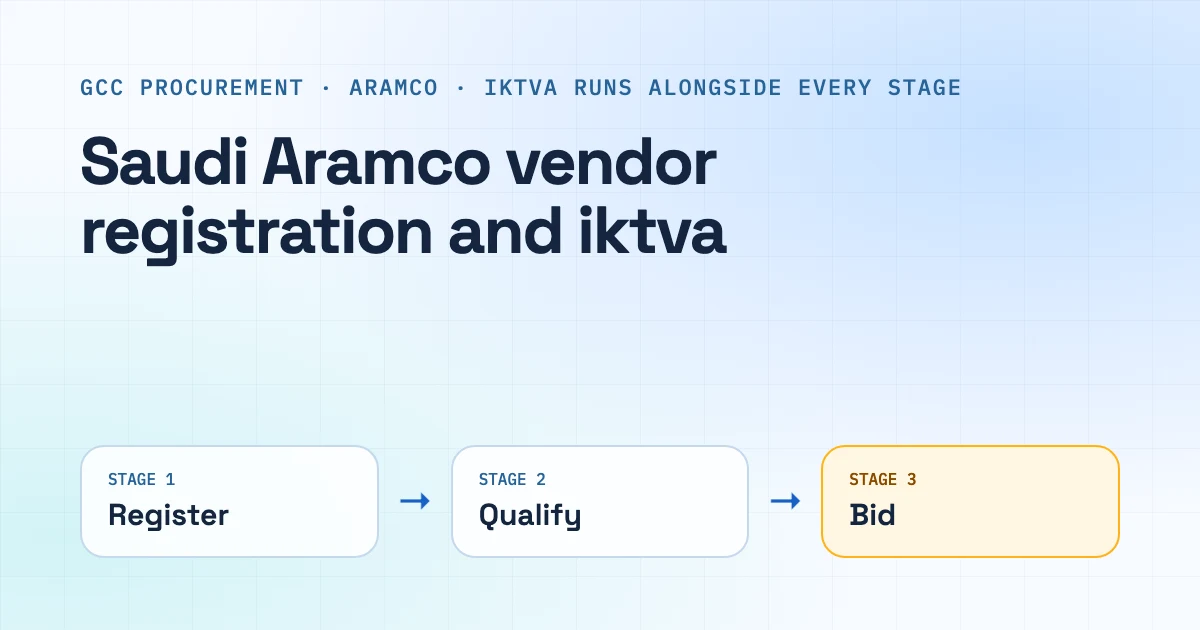
Plan for three stages, not one:
- Register with the documents for your route and supplier type.
- Qualify for your specific materials or services, under the requirements for your supplier type.
- Bid when invited, following each tender’s documents, including any iktva requirements.
Read a registration confirmation as a file in the system, not as approval. Keep your qualification evidence ready, and expect the buyer to look at it next.
Keep Your Public Profile Consistent With Your File
The portal is not the only place a buyer can check you. Procurement staff and engineers can look up your website and company profile, then compare them with your registration file.
Check whether your website states the same facts your file does:
- Legal entity and licence. Your registered company name and CR number, if you are in-Kingdom.
- Supplier type and scope. Whether you are a material vendor, manufacturer or service provider, and for which products or services.
- iktva status. Current, with the date it was certified, if you choose to publish it.
- Certificates with dates. ISO certificates and other approvals, each with an expiry date.
- A named contact. A person, a direct phone number and an email address.
Examples are illustrative, not client case studies. A weak line reads: “Committed to the Kingdom’s local content goals.” Nothing in it can be checked. A stronger line reads: “iktva certified by an approved audit firm, [month and year].” A buyer can compare that with your file.
If your public profile does not match your registration file, see what evaluators check on your website, or start with a website built for pre-qualification checks.
Frequently Asked Questions
Do suppliers outside Saudi Arabia need the in-Kingdom documents?
No. Aramco states that its in-Kingdom document list is “not applicable to suppliers based outside of Saudi Arabia.” Suppliers in the other GCC states and in ten listed countries, including Egypt, Jordan and Pakistan, register through the e-Marketplace Platform via Dhahran. Suppliers in all other countries contact the regional Aramco affiliate.
Is iktva required to work with Aramco?
iktva.sa states that participation “is required for doing business with Saudi Aramco.” The process runs through a survey certified by an approved audit firm and a five-year action plan. How iktva counts in a particular bid is set by that tender’s documents.
How long is Aramco’s Cybersecurity Compliance Certificate valid?
Aramco states that “the CCC is valid for two years from the issuance date.” Assessments are carried out by audit firms Aramco has authorised. Third parties classified as Network Connectivity or Critical Data Processor need the CCC+.
Does registering with Aramco mean I will receive tenders?
No. Aramco states that registering and then qualifying “does not guarantee you future business with Aramco.” Registration and qualification let you be considered. Your qualification evidence and each bid still decide the outcome.
Before You Open the e-Marketplace
Confirm your route by location, then your supplier type and forms. If you are in-Kingdom, gather the full document list, including a current CCC. Start iktva early, because it runs on a certified survey and a five-year plan. Treat registration, qualification and bidding as three separate gates.
Your website is part of the record a buyer can check. To see how it reads next to your registration file, request a free website audit.
About the Author
Danil Shtankov is the founder of Wattpixel. He spent five years in power generation business development. Read more about Wattpixel or follow Wattpixel on LinkedIn.
Sources
- Aramco, “Become a supplier” (undated page, checked 29 October 2026)
- Aramco, “International suppliers” (checked 29 October 2026)
- Aramco, “Supplier resources” (checked 29 October 2026)
- Aramco, “Cybersecurity Compliance Certificate program” (checked 29 October 2026)
- Aramco, “Ethics and compliance” (checked 29 October 2026)
- Aramco, “In-Kingdom Total Value Add (iktva)” (checked 29 October 2026)
- iktva, “How to participate in iktva” (checked 29 October 2026)
- iktva, “Downloads” (checked 29 October 2026)
- U.S. International Trade Administration, “Saudi Arabia: Becoming an Aramco Supplier” (published 19 May 2020, checked 29 October 2026)
- Aramco Elements magazine, executive interview (published 15 December 2019, checked 29 October 2026)