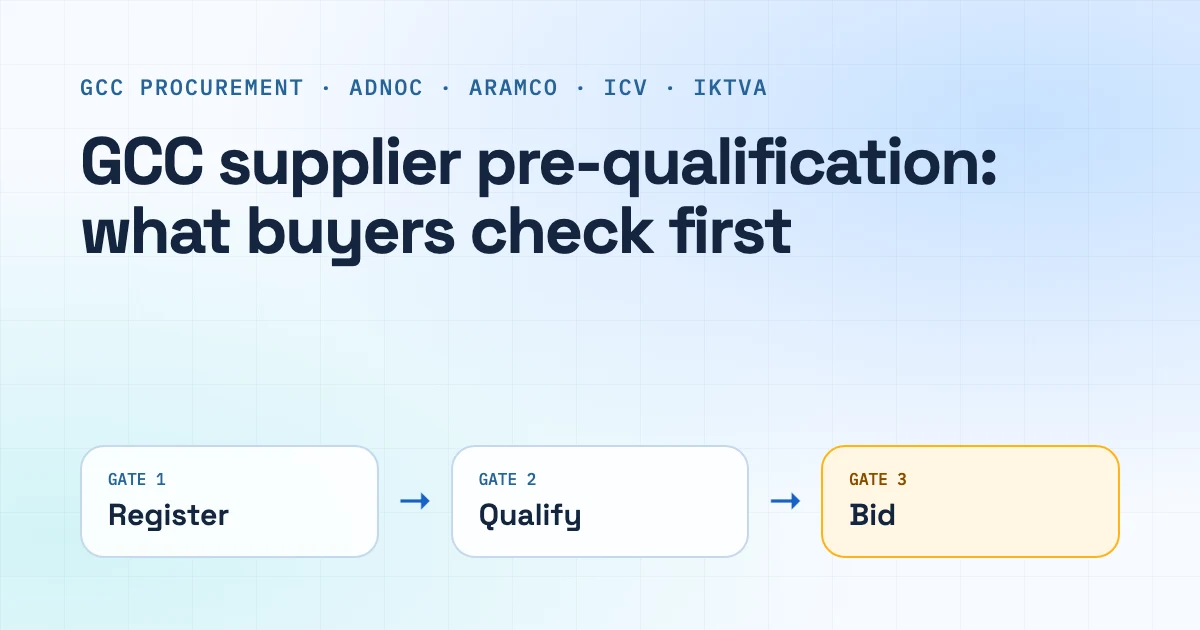
You register on a buyer’s supplier portal, upload a folder of documents and wait. Weeks pass. No request for quotation (RFQ) arrives, and nobody calls. That silence is often not a rejection. Registration is only the first of three gates.
Short answer: In the GCC, getting on a buyer’s shortlist happens in stages: registration on the buyer’s supplier portal, qualification for specific products or services, then bidding. Procurement checks licences, ownership, finances, HSE and quality systems, local value (ICV in the UAE, iktva for Aramco) and similar past work. Registration alone does not guarantee work; Aramco says so itself. One current evidence folder saves time on every portal.
The rules also differ by buyer and by country. ADNOC, Aramco and Saudi government entities each run their own process on their own systems. Much of the guidance online comes from consultancies, and some of it is several years old.
This guide focuses on buyers in the UAE and Saudi Arabia and sets out the sequence: register, qualify, bid. It covers the evidence procurement asks for at each stage, and every programme rule I state links to its official source. It also covers a step most guides skip: the check buyers can run on your website and company profile.
In my five years in power generation business development, I completed many of these registrations myself. Where this article draws on that experience, I say so. The same gates apply whether you work in EPC contracting or oil and gas services.
Registration, Qualification, Bidding: Three Different Gates
Registration gets your company into a buyer’s system. Qualification is the buyer deciding you are fit to supply specific products or services. Bidding is where your offer competes on technical compliance, price and, when the tender asks for it, local value.
Suppliers often treat these as one step. Buyers do not. Aramco’s supplier page describes registration through its e-Marketplace platform, with qualification as a separate step (Aramco, Become a supplier, checked 29 October 2026).
The same page is direct about what comes after: “registering and then qualifying as an Aramco supplier does not guarantee you future business with Aramco.” Qualification puts you in a position to be invited. It does not put work in your pipeline.
ADNOC also separates the stages. Registration runs through the ADNOC Supplier Hub. The Hub’s registration user manual shows that your licence type decides which form you complete. You then enter company details and preview the application before you submit it (ADNOC Supplier Hub, Registration User Manual, checked 29 October 2026).
That manual is about registration. For what follows, third-party guides such as Shuraa’s ADNOC vendor registration guide describe a profile questionnaire, integrity due diligence and pre-qualification. Treat that sequence as a consultancy’s summary, and confirm the current steps in the Supplier Hub itself.
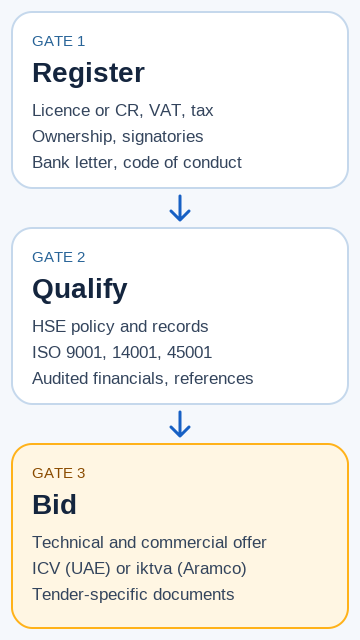
| Gate | What it decides | What procurement looks at |
|---|---|---|
| 1. Register | Whether your company exists in the buyer’s system | Licences, tax and ownership documents, bank details, authorised signatories |
| 2. Qualify | Whether you can supply a specific scope | Technical capability, HSE, quality systems, financial standing, references |
| 3. Bid | Whether this offer wins this tender | Technical compliance, price, and local-value commitments where the tender requires them |
The bid itself usually combines a technical offer, a commercial offer and any forms the tender asks for, including local-value documents where they apply. Each tender’s documents list exactly what to submit, so treat them as the checklist for that bid.
Do not read a registration confirmation as approval. It means your file is in the system. Qualification for your product or service categories is a separate decision, and winning a tender is a third.
What Procurement Asks For at Registration
Expect corporate, tax and ownership documents first. The exact list varies by buyer, by country and by whether you register a local entity or a foreign one.
Aramco publishes one of the clearest lists. For in-Kingdom suppliers, its supplier page asks for the following (Aramco, Become a supplier, checked 29 October 2026):
- Commercial Registration (CR), the company’s trade registration certificate
- Zakat certificate
- VAT registration certificate
- GOSI certificate (General Organization for Social Insurance)
- Civil Defense licence, or an equivalent licence
- Chamber of Commerce membership
- Acknowledgement of the Aramco Supplier Code of Conduct
- Bank letter
- Ownership profile
- Authorised signatory letter
- Cybersecurity Compliance Certificate
Suppliers based elsewhere in the GCC and the wider Middle East follow a different route. According to the same page, they register with Aramco’s Dhahran office through the e-Marketplace platform.
ADNOC’s Supplier Hub form is driven by your licence type, as its registration manual shows. Have your trade licence and company details ready before you start, because the form follows them.
Every buyer runs its own registration
The documents look similar from buyer to buyer, but each portal works differently. I have personally completed supplier registration with ADNOC, DEWA, TAQA, Etihad Rail, Emirates Global Aluminium and Petrofac, among others. Each ran its own process on its own platform.
Those platforms included SAP Ariba, Oracle iSupplier, SAP supplier portals, IBM Maximo and in-house portals. In my experience, you enter the same company information, upload the same certificates and confirm the same bank details on each one.
That repetition is the practical case for a single, current evidence folder. The checklist later in this guide shows what to put in it.
What Gets Checked at Pre-Qualification
Pre-qualification tests whether you can deliver a specific scope safely and reliably. Expect questions on technical and operational capability, HSE, quality systems, financial standing and references.
In my experience, large contractors and owners request a lot of information at this stage. The process inside each company is long, from your HSE policy to your audited financial statements.
The forms below are published examples from individual companies. They are not ADNOC or Aramco forms. They show the kind of evidence a pre-qualification questionnaire (PQ) asks for.
Quality, environmental and safety management systems
GGR Group’s supplier pre-qualification questionnaire (2023) asks about ISO 9001, ISO 14001 and ISO 45001 certification. ISO 9001 covers quality management. ISO 14001 covers environmental management, and ISO 45001 covers occupational health and safety.
The same form asks about the certifier’s accreditation. That question suggests buyers look at who issued a certificate, not only whether you hold one. Keep each certificate with its scope statement, issuing body and expiry date.
HSE evidence beyond certificates
HSE stands for health, safety and environment. Certificates are only part of the picture. A Kuwait Oil Company (KOC) HSE pre-qualification section, shared as a user-uploaded copy on Scribd, goes further. It asks how you maintain HSE-critical equipment, personal protective equipment (PPE) and vehicles.
That document is a user-uploaded copy, so treat it as an illustration of the questions rather than a current form. Be ready to show how you maintain equipment, issue PPE and manage your vehicles. Records answer those questions better than policy statements do.
Financial standing and references
APL’s contractor pre-qualification form PF-001 (December 2024) asks for three years of audited financial statements and client references. It comes from a company outside the GCC. I include it because it states the financial request plainly.
If your accounts are not audited, or your last audit is out of date, fix that before you apply. References carry more information when they name the client, location, scope and year.
Capability and equipment
Capability questions test whether you can deliver the scope you applied for. Be ready to list the services you deliver, your key people, the equipment you own and comparable projects with their size and location.
Avoid answering with adjectives. “Extensive experience” tells an evaluator nothing they can check. A list of similar projects with dates and capacities gives them something to verify.
Local Value: ICV in the UAE, iktva for Aramco
ICV and iktva both measure how much value a supplier creates in the local economy. How that score counts in a particular bid is set out in each tender’s documents, so read them every time.
ICV in the UAE
ICV stands for In-Country Value. The UAE National ICV Programme is led by the Ministry of Industry and Advanced Technology (MoIAT). ICV certificates are issued by certifying bodies that MoIAT approves.
In a release dated 31 March 2022, MoIAT reported approving 21 companies to issue ICV certificates. The release also states that companies wishing to benefit from the programme must obtain a certificate (MoIAT, ICV release, checked 29 October 2026).
Published guidance on two points conflicts: how long a certificate stays valid, and whether ADNOC requires one for every tender. I do not state either here. Check the validity rules with MoIAT and the requirements in each ADNOC tender.
iktva for Aramco
iktva stands for In-Kingdom Total Value Add. Aramco describes the programme as “designed to drive supply-chain efficiency and value across our operations” (Aramco, Become a supplier, checked 29 October 2026). According to the U.S. International Trade Administration, all Aramco suppliers must contribute to iktva and report across eight categories. Its examples include “Localized Goods & Services” and “Salaries Paid to Saudis” (trade.gov, Becoming an Aramco Supplier, published 19 May 2020, checked 29 October 2026). That summary is several years old, so work from Aramco’s current guidance for the details.
Show your status outside the tender
A common belief is that an ICV certificate only matters to the tender committee. The certificate is also evidence for anyone checking your company. If your ICV certificate or iktva status is current, state it on your website and company profile, with the date.
I am not an ICV or iktva consultant, and this is not certification advice. For certification, use an approved certifying body or an accredited adviser.
Programme rules change; check the current requirements with MoIAT, ADNOC and Aramco. Checked: 29 October 2026.
Public Tenders in Saudi Arabia: Etimad
Etimad is the Saudi government procurement e-platform. The Ministry of Justice’s tenders page describes it as the platform that provides Ministry of Finance procurement services (Ministry of Justice, Tenders, checked 29 October 2026).
If you want Saudi public-sector work, check whether the entity you are targeting publishes its tenders on Etimad. Aramco runs its own e-Marketplace registration, so treat Etimad as a separate registration with its own requirements.
Energy work can add another layer. In my experience, energy-sector work in Saudi Arabia can also require registration with the Ministry of Energy; check the tender documents for each project. I have not found an official Ministry of Energy page that sets out the scope, so confirm it with the buyer.
What Buyers Check Outside the Portal
The portal is not the only place a buyer can check you. Before or after the questionnaire, engineers and procurement staff can look up your website, company profile PDF and LinkedIn page. They can then compare what they find with what your forms claim.
The forms ask for evidence. Your public profile either supports that evidence or raises questions about it. In my experience, a clear website and company profile always help. That is my view from the supplier side, not a measured result. For a page-by-page view of what to publish, see what evaluators check on your website.
What a buyer looks for
When someone checks you online, these are the details that let them confirm your forms:
- Scope and capacity in numbers. For example, the kVA (kilovolt-ampere) range of your generator fleet, crew sizes or annual output.
- Project references. Client type, location, size and year for each project you are allowed to name.
- Certifications and approvals with dates. ISO certificates, vendor approvals and their expiry dates.
- ICV or iktva status. Current, with the date it was issued or checked.
- HSE record. Policy and any statistics you are allowed to share.
- Local presence and licence. Office address, trade licence or CR number.
- A named contact. A person, a direct phone number and an email address.
Common gaps
In my experience, the same gaps undermine otherwise solid suppliers:
- A company profile that has not been updated in years
- Projects listed without size, location or date
- Approvals buried in a PDF that is hard to find
- No Arabic version for Saudi buyers
- No named contact, only a generic form
An illustrative before and after
Examples are illustrative, not client case studies.
A weak capability line reads: “Leading provider of reliable power solutions across the region.” Nothing in it can be checked.
A stronger line reads: “Diesel generator rental from 20 kVA to 2,000 kVA, with units based in Abu Dhabi and Dammam.” An engineer can compare that with your PQ answers in seconds.
The same applies to projects. “Numerous successful projects” tells a buyer nothing. “Temporary power for a 12-month substation upgrade, Abu Dhabi, 2024” gives them a client type, a scope and a date to verify.
If your public profile does not yet match your PQ answers, start with a website built for pre-qualification checks. The same applies to O&M and power services companies, where O&M means operations and maintenance. For them, crews, response times and service records do the talking.
How Often People Search for These Terms
Search estimates show regular demand for answers about ICV, iktva, Etimad and vendor registration. I pulled estimated monthly searches from Ubersuggest in October 2026 for five procurement terms.
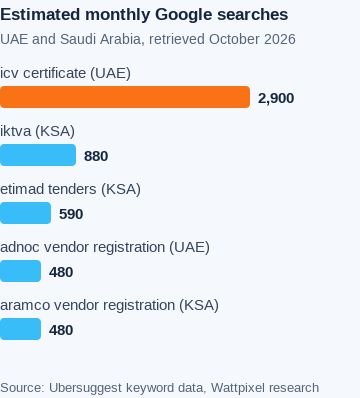
Source: Ubersuggest keyword data for the UAE and Saudi Arabia, retrieved October 2026. Estimates, not a count of suppliers.
Together, the five terms total about 5,330 estimated searches a month. These are keyword estimates for the UAE and Saudi Arabia, not a count of suppliers. They show regular demand for answers about ICV, iktva, Etimad and vendor registration.
A Readiness Checklist Before You Register
Gather the evidence once, keep it current, and publish what is not confidential. That covers most of what any portal will ask for.
In my experience, what slows suppliers down is the sheer amount of company data requested. Each new portal asks for it again. With one prepared folder, each registration becomes a matter of uploading rather than searching.
| Item | What to include | Where it lives |
|---|---|---|
| Documents folder | Trade licence or CR, tax and VAT certificates, social insurance, chamber membership, bank letter, ownership profile, signatory letter | Internal |
| Certificates register | ISO certificates, ICV or iktva status, vendor approvals, each with issue and expiry dates | Internal; publish the current ones |
| Project reference sheet | Client (where permitted), location, scope, capacity, year | Website and company profile |
| Financials | Three years of audited financial statements | Internal; shared on request |
| HSE pack | HSE policy, statistics you are allowed to share, equipment maintenance and PPE records | Policy and approved statistics public; records internal |
| Company profile | An updated PDF that matches your website | Website download |
| Website pages | Capabilities, projects, certifications, contact | Public |
Set a review date for every document that expires. An expired certificate on a portal or a website can raise more questions than a missing one.
Keep one person responsible for the folder. When a buyer’s portal asks for a document, that person should know where the current version is.
Frequently Asked Questions
Is vendor registration the same as pre-qualification?
No. Registration puts your company into a buyer’s system, and pre-qualification is a separate assessment for specific products or services. Aramco describes qualification as a separate step after registration on its supplier page. ADNOC’s Supplier Hub manual covers registration, while third-party guides describe questionnaire, due diligence and pre-qualification stages after it.
Do I need an ICV certificate to bid for ADNOC tenders?
Check each tender’s documents. MoIAT states that companies wishing to benefit from the ICV programme must obtain a certificate from an approved certifying body. Published sources disagree on a blanket rule for ADNOC tenders. Read the requirements in each tender and confirm with MoIAT (checked 29 October 2026).
What documents does Aramco ask suppliers to provide?
For in-Kingdom suppliers, Aramco lists corporate, tax and compliance documents. These include CR, Zakat, VAT and GOSI certificates, a Civil Defense or equivalent licence, and Chamber of Commerce membership. The list also includes a Supplier Code of Conduct acknowledgement, bank letter, ownership profile, authorised signatory letter and Cybersecurity Compliance Certificate. Suppliers elsewhere in the GCC and the wider Middle East register with Aramco’s Dhahran office through the e-Marketplace platform (checked 29 October 2026).
What should a contractor’s website show to pass a pre-qualification check?
No website passes pre-qualification on its own; the decision happens in the buyer’s process. A website can confirm what your forms claim. Show your capabilities in numbers, dated project references, certifications with expiry dates and your local presence. Add a named contact so the buyer knows who to call.
Ready Before the Buyer Calls
Registration, qualification and bidding are three separate gates, and each asks for evidence rather than claims. Local value, through ICV in the UAE or iktva for Aramco, can shape how a bid is assessed. Your website and company profile are part of the record a buyer can check, so keep them consistent with your forms.
Start with the readiness checklist, then compare your public profile with your PQ answers. If you want an outside view, Wattpixel’s free website audit lets you see what a procurement engineer sees when they look you up.
About the Author
Danil Shtankov is the founder of Wattpixel. He spent five years in power generation business development, working across generator rental, EPC, CHP and O&M, and has personally completed supplier registration with major buyers in the UAE. Read how we work, follow Wattpixel on LinkedIn, or get in touch.
Sources
- Aramco, “Become a supplier” (checked 29 October 2026)
- ADNOC Supplier Hub, “Registration User Manual” (checked 29 October 2026)
- Ministry of Industry and Advanced Technology (MoIAT), ICV release, dated 31 March 2022 (checked 29 October 2026)
- Ministry of Justice, Kingdom of Saudi Arabia, “Tenders” (checked 29 October 2026)
- U.S. International Trade Administration, “Saudi Arabia: Becoming an Aramco Supplier” (published 19 May 2020, checked 29 October 2026)
- Shuraa, “ADNOC Vendor Registration” (third-party guide)
- GGR Group, “Supplier Pre-Qualification Questionnaire” (2023)
- APL, “PF-001 Category R LPG Consultancy Provider” (December 2024)
- KOC HSE pre-qualification section, form PQ-16-04B (user-uploaded copy on Scribd, not an official KOC publication)
- Ubersuggest keyword data for the UAE and Saudi Arabia, retrieved October 2026 (Wattpixel research)