Before a buyer sends you a pre-qualification questionnaire (PQ), someone on their side may open your company profile. Within a few pages, they can tell whether your claims are checkable. That often makes the PDF the first document a buyer reads, whether or not the tender asks for it.
Short answer: A company profile for tenders should answer what a pre-qualification form will ask. That means who you are, who runs the company and what you deliver. It also covers your people, equipment, projects, HSE and quality systems, and current certificates. Give every claim a number, a date or a third-party source. Keep the PDF searchable, match it to your website and review it whenever a certificate expires.
For where the profile sits in the wider process of registration, qualification and bidding, start with the GCC supplier pre-qualification guide. This guide stays with the PDF itself: its length, a page-by-page structure, the evidence on each page and how to maintain it.
Why Buyers Treat the Profile as Evidence
Some GCC registration forms ask for a company profile by name. The Abu Dhabi Judicial Department (ADJD) lists “Company profile and organizational structure” among the documents it requires from high-risk suppliers. The same list includes ISO 45001 and other ISO certificates (ADJD supplier registration, checked 29 October 2026).
That list also asks for “The employees list of the establishment, their qualifications and previous experience”. Its general list adds copies of HSE compliance certificates, “if any”. HSE stands for health, safety and environment.
Dubai Land Department’s supplier registration form has an upload field labelled “Company profile and previous work”. The field is not marked mandatory (Dubai Land Department, supplier registration, checked 29 October 2026). If you leave it empty, the buyer simply has less to go on.
Not the same as an ownership profile
Aramco asks in-Kingdom suppliers for “A valid Company Ownership Profile with required supporting documents” (Aramco, Become a supplier, checked 29 October 2026). The name is similar, but it is a separate requirement about ownership. Prepare it from Aramco’s instructions, not from your brochure.
A profile does not qualify you
QatarEnergy states that “Notification of Registration does not signify or confirm QatarEnergy’s qualification or pre-qualification” (QatarEnergy, Vendor Registration, checked 29 October 2026). Aramco also says registration and qualification do not guarantee business.
Your profile will not win a tender on its own. Its job is to make every later answer in the PQ easy to verify.
Programme rules change; check the current requirements with ADJD, Dubai Land Department, QatarEnergy and Aramco. Checked: 29 October 2026.
How Long Should a Company Profile Be?
No official rule sets a length. The Queensland Government (capability statement guidance, updated 29 August 2022) says a capability statement “can vary from a single-page summary to an extensive, multi-page document, depending on how you want to use it.” It also advises you to “keep it short and sharp”.
Western Australia’s Small Business Development Corporation (capability statement article, 14 September 2022) says one “could be a couple of paragraphs through to several pages”. Both are Australian small-business sources, not GCC procurement rules. Their point still holds: length follows use.
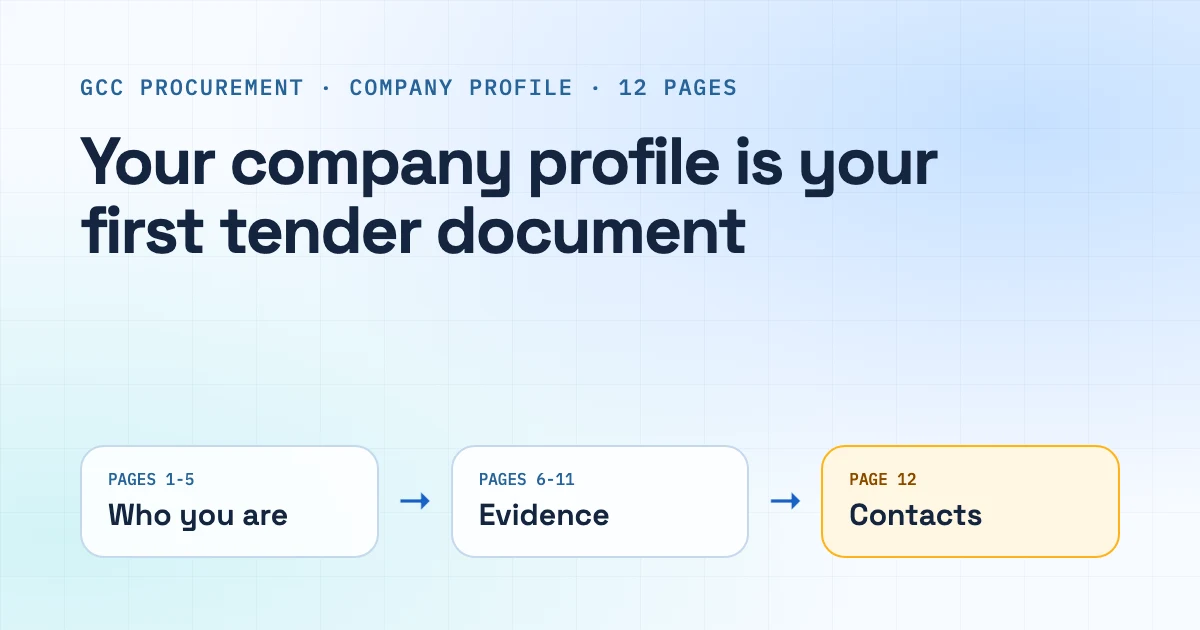
For a tender profile, about 12 pages works best in my experience. The structure below uses that length, with one main topic per page.
The same Western Australian guidance notes: “You may need different versions for different audiences.” A two-page summary for introductions and exhibitions can sit alongside the full tender version. Build both from the same set of facts, so they never disagree.
A 12-Page Structure Mapped to Pre-Qualification
Each page answers a topic buyers check. The forms cited above ask about organisation, people, previous work, HSE and certificates; PQs commonly add equipment and financial standing. Adapt the order to your sector, but keep one topic per page so an evaluator can find it fast.
| Page | Title | What to include | What it answers for the buyer |
|---|---|---|---|
| 1 | Cover | Legal company name, one-line scope, version date, named bid contact | Who you are, and whether this copy is current |
| 2 | Company overview | Legal entity, trade licence or Commercial Registration (CR) number, year founded, offices, ownership summary | Registration details the buyer will cross-check |
| 3 | Organisation and key people | Organisation chart, named managers, their qualifications | ADJD’s “organizational structure”; who the buyer would work with |
| 4 | Scope and capabilities | Services and products in numbers: kVA ranges, voltages, crew sizes, output | Whether you can deliver this scope |
| 5 | Manpower and equipment | Headcount by discipline, owned equipment, bases and workshops | Staff qualifications and experience; capacity to mobilise |
| 6 | Project references (1) | Most relevant projects: client type, location, scope, capacity, your role, year | Similar past work |
| 7 | Project references (2) | Further projects, grouped by sector or country | “Previous work”, as Dubai Land Department’s form puts it |
| 8 | Client references and third-party proof | Reference letters, completion certificates, coverage you may cite | Independent confirmation of your claims |
| 9 | HSE management | HSE policy, management system, ISO 45001, statistics you are allowed to share | HSE capability and compliance |
| 10 | Quality and certificates | ISO certificates with scope, certifying body and expiry date | Whether each certificate is valid for this scope |
| 11 | Registrations and local value | Vendor registrations, utility approvals, ICV or iktva status, each with dates | Where you are already registered or approved |
| 12 | Financial standing and contacts | A summary you are willing to share, audited accounts available on request, direct contacts | Commercial risk, and who to call |
kVA means kilovolt-ampere, the usual rating for generators and transformers. ICV is the UAE’s In-Country Value programme, and iktva is Aramco’s In-Kingdom Total Value Add programme.
Write Evidence a Buyer Can Check
A page earns its place when an evaluator can check what it says. The Queensland guidance says a capability statement should “prove how you can solve problems for prospective clients”. It also suggests using “information from third parties such as client references or media coverage”.
HSE pages that can be scored
In oil and gas, IOGP Report 423 is the industry guideline for HSE management in contracts, including contractor selection. It “establishes a structured approach to control HSE risk in a contract environment” (IOGP Report 423).
A companion document, IOGP 423-01, adds guidance on “a contractor HSE capability assessment questionnaire and scoring system” (IOGP 423-01). Some buyers set their own standard. QatarEnergy says its contractors “must comply with the QatarEnergy Corporate Standard for Managing HSE in Contracts” (QatarEnergy, Contractor HSE Management, checked 29 October 2026).
If your buyers assess HSE this way, your HSE page should state facts a questionnaire can score. Name the management system, its certificate and expiry date, and how you train and report. Slogans about safety culture give an evaluator nothing to mark.
Dates on everything that expires
Show each certificate with its issuing body, scope and expiry date. Do the same for vendor registrations, such as ADNOC’s, and ICV or iktva status. An undated certificate prompts a follow-up question, and an expired one prompts a harder one.
Before and after
Examples are illustrative, not client case studies.
A weak capability line reads: “A trusted partner with extensive experience in power projects across the region.” An engineer cannot check any part of it.
A stronger line reads: “Medium-voltage cable jointing and testing up to 33 kV, with 40 certified jointers based in Abu Dhabi.” It gives a scope, a limit, a team size and a location.
A weak project entry reads: “Major substation project for a leading utility.” A stronger one reads: “Temporary power for a 132 kV substation upgrade, Abu Dhabi, 2024, 12 months, main subcontractor.” That entry states your role, a common buyer question.
What Usually Weakens a Profile
The same problems tend to recur across company profiles. Check yours against this list before your next submission:
- Adjectives instead of numbers. “Leading”, “extensive” and “reliable” cannot be verified.
- Projects without context. A project name with no year, location, capacity or role says little.
- Client logos with no scope. A logo shows a relationship existed, not what you delivered.
- Undated or expired certificates. These invite doubt about everything else in the file.
- No version date. The buyer cannot tell whether the copy is from this year or several years ago.
- Facts that differ from the website. Different headcounts or project lists suggest one source is out of date.
- A scanned PDF. Text in an image cannot be searched or copied into an evaluation sheet.
Questions Buyers Often Follow Up With
These are typical follow-up questions, not a record of any one buyer. Answer them in the profile and you save a round of emails:
- Was this project your scope, or a subcontractor’s?
- Is this certificate current, and does its scope cover the work in this tender?
- Who on this organisation chart would lead our project?
- Is this equipment owned or hired in?
- Can we contact this client for a reference?
- Which legal entity signs the contract, and is it the one registered on our portal?
The last question matters for groups with several entities across the GCC. State on page 2 which entity the profile describes.
Make the PDF Work on Supplier Portals
A profile is only useful if the buyer can search it. GOV.UK guidance on publishing accessible documents warns that with scanned pages, “users will not be able to search the content and it won’t be read by a screen reader” (GOV.UK, Publishing accessible documents, updated 9 October 2025, checked 29 October 2026).
That guidance is written for UK government publishers, but the mechanics apply to any PDF. It advises you to “convert the scanned text using Optical Character Recognition (OCR)”. It also says: “Make sure your source document is accessible before you convert to PDF.”
A short checklist for the file:
- Export from the source document rather than scanning a printed copy.
- Open the PDF and confirm you can select and search the text.
- Run OCR on any scanned certificate you include.
- Name the file with the company name, “company profile” and the version date.
- Check the portal’s stated upload limit, and compress photos rather than removing facts.
Keep the Profile and the Website in Step
Buyers can compare your PDF with your website, your PQ answers and your LinkedIn page. The page list in what evaluators check on your website mirrors most of the profile above. Use the same figures, project entries and certificate dates in both places.
QatarEnergy states that “Existing registered Vendors must keep their information on record with QatarEnergy current”. Apply the same discipline to your profile, even where no buyer requires it.
A simple maintenance routine
- One owner. Name one person responsible for the profile and its source file.
- Trigger-based updates. Update when a certificate is renewed, a project completes or a key person leaves.
- A regular review. We recommend checking every page at least once a quarter.
- A version date on the cover. Change it with every update, and replace the download on your website the same day.
For EPC contractors and industrial manufacturers, the project and certificate pages change most often. If your profile, website and LinkedIn tell different stories, brand and growth strategy work starts by agreeing one set of facts.
Frequently Asked Questions
What is the difference between a company profile and a capability statement?
They describe the same kind of document. “Capability statement” is the term used in the Australian guidance cited here. GCC registration forms, such as those from ADJD and Dubai Land Department, say “company profile”.
Should a company profile include financial statements?
A summary of financial standing is usually enough in the profile. Buyers that want audited statements normally request them through their own portal. We recommend stating that audited accounts are available on request, rather than publishing them in a public PDF.
How often should I update my company profile?
Update it whenever something in it changes or expires, and review every page at least once a quarter. Put a version date on the cover. A buyer should never have to guess how old the copy is.
Can I use one company profile for every buyer?
You can use one set of facts for every buyer. Western Australia’s Small Business Development Corporation notes that you may need different versions for different audiences. Keep a full tender version and a short summary, and reorder project references to match each buyer’s sector.
Your Profile Opens the File
A tender profile works when each page answers a pre-qualification question with evidence a buyer can check. About 12 pages, one topic per page, dates on everything that expires, and the same facts as your website.
When you have revised it, compare the PDF with your website page by page. Wattpixel’s free website audit checks whether your capabilities, proof and RFQ path are easy for a buyer to find. Use it alongside your page-by-page check.
About the Author
Danil Shtankov is the founder of Wattpixel. He spent five years in power generation business development and has personally completed supplier registration with major buyers in the UAE. Read about Wattpixel or follow Wattpixel on LinkedIn.
Sources
- Abu Dhabi Judicial Department, “Application for Registration of Suppliers, Contractors and Service Providers” (undated; checked 29 October 2026)
- Dubai Land Department, “Supplier Registration” (checked 29 October 2026)
- QatarEnergy, “Vendor Registration” (checked 29 October 2026)
- QatarEnergy, “Contractor HSE Management” (checked 29 October 2026)
- Aramco, “Become a supplier” (checked 29 October 2026)
- IOGP, Report 423, HSE management in contracts (v3.00, 24 April 2017)
- IOGP, Report 423-01, contractor HSE capability assessment questionnaire
- Queensland Government, “Capability statement” (updated 29 August 2022)
- Small Business Development Corporation, Western Australia, “Does your business need a capability statement?” (14 September 2022)
- GOV.UK, “Publishing accessible documents” (updated 9 October 2025)